Bearss Lime (Bearss Lemmetjie) #
Citrus x latifolia
Quick Info #
- Distribution & habitat: believed to originate in Southeast Asia – now in many countries in tropical and subtropical regions
- Family: Rutaceae
- Florescence: blooms all year in its hardiness zones
- Fruiting: -
- Leaf habit: evergreen in its hardiness zones or warm climates
- Name origin: T.J. Bearss discovered the limes in 1895
- Other names: Persian lime, seedless lime, Tahiti lime
Description #
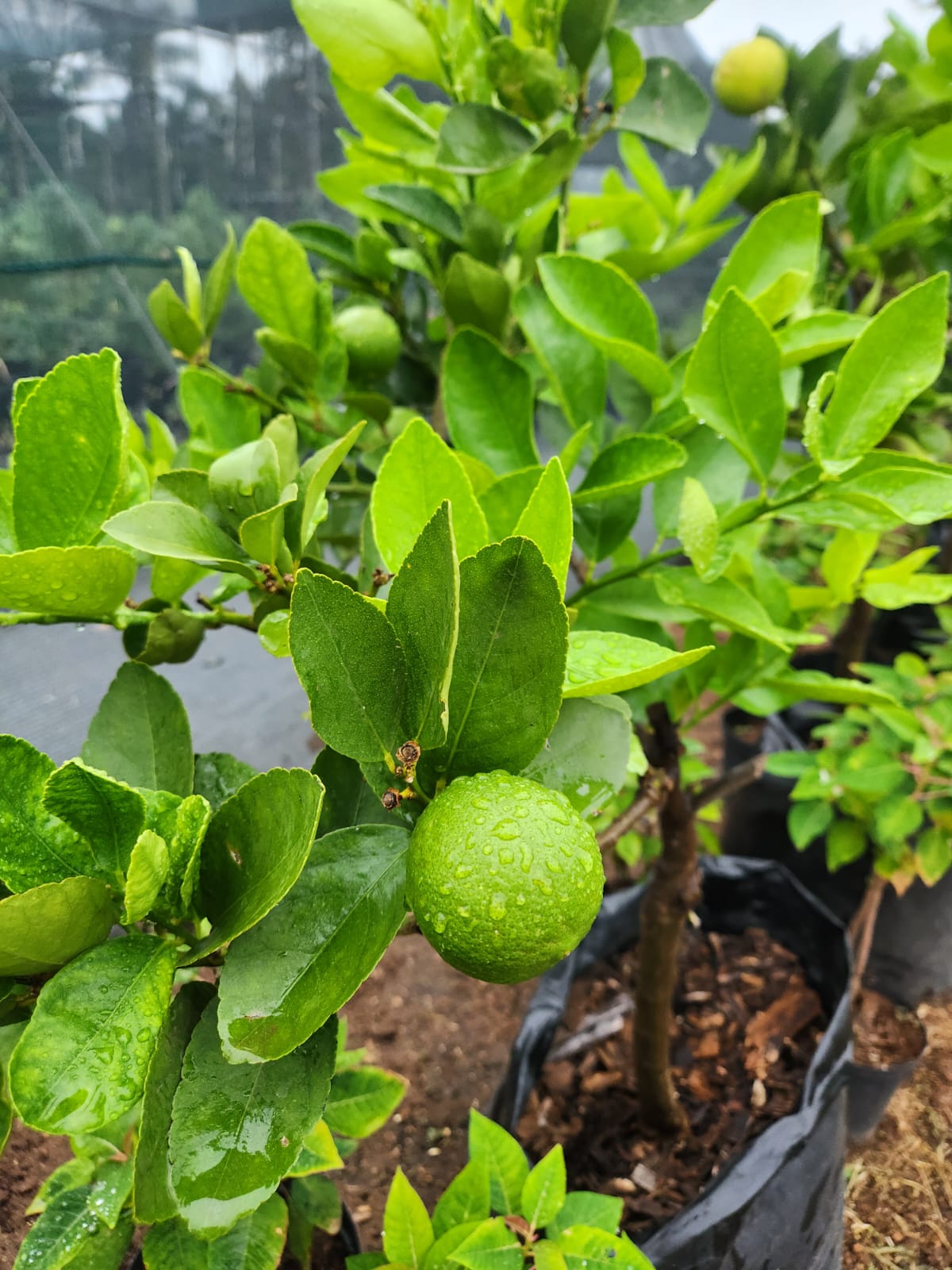
The Bearss lime is a smallish tree, growing up to only about 6 metres. A nearly-thornless hybrid between the key lime and lemon, it is more resistant to cold than other limes. It has a dense, lush, roundish canopy, which may droop to the ground, and a symmetrical, weeping form. Its fruits are aromatic, juicy, seedless limes, which are often harvested green but do ripen to be fragrant, sweet and yellow. Interestingly, the limes may contain a few seeds if the trees are planted among other fruit trees.
The leaves, although initially tinged purple, are lanceolate and dark green on top with a lighter shade underneath. The star-shaped flowers grow in clusters of five to ten, with white petals, which are also initially tinged purple. The fruits are oval-shaped.
Uses & Ecology #
When harvested green, as is common, the limes are particularly acidic or tart. It has a long shelf life and its fine flavour allows for use in a wide variety of dishes. The lime juice is high in some vitamins and antioxidants.
The sweet fragrance of the flowers attracts pollinators such as bees.
Caution: Do not medically use or ingest any plant parts before consulting a qualified health practitioner. Any mentioned traditional uses are based on cultural practices and anecdotal evidence. They are not necessarily clinically proven or supported by modern scientific studies.
References #
- Gardenia (n.d.) Available at: https://www.gardenia.net/plant/citrus-latifolia (Accessed: 10 December 2025)
- NC State (n.d.) Available at: https://plants.ces.ncsu.edu/plants/citrus-x-latifolia/ (Accessed: 10 December 2025)
- Plantids (n.d.) Available at: https://plantids.com/746-citrus-x-latifolia.html (Accessed: 11 December 2025)
- Specialty Produce (n.d.) Available at: https://specialtyproduce.com/produce/Bearss_Limes_13176.php (Accessed: 11 December 2025)