Variegated Rubber Tree (Rubberboom) #
Ficus elastica variegata
Quick Info #
- Distribution & habitat: native to South and Southeast Asia – favours colder climates or tropical regions that offer direct sunlight
- Family: Moraceae
- Florescence: -
- Fruiting: -
- Leaf habit: evergreen
- Name origin: “ficus” means “fig”, “elastica” means “elastic” and “variegata” refers to variegation
- Other names: Indian rubber bush, Indian rubber tree, rubber fig, rubber bush, rubber plant and rubber tree plant
Description #
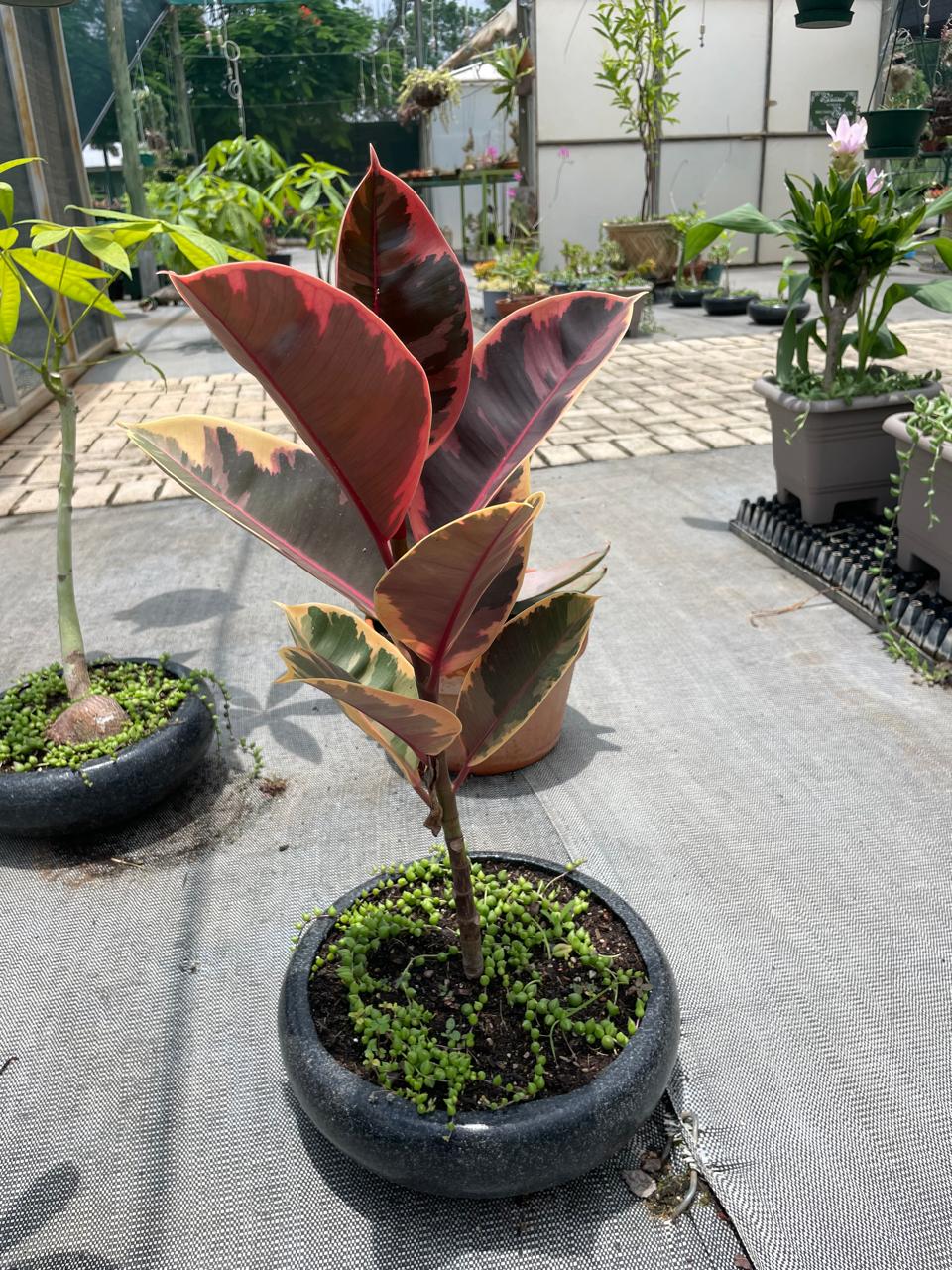
The variegated rubber tree is popular for its use as a potted plant inside the house, where it likely grows up to about 3 metres, but in nature it may reach 12 metres. It has big, glossy leaves with creamy-white or yellowish-green, widely varying variegation patterns over a green background. The colours can vary, however, between pink, white and dark red. The leaves are smooth, wide and ovoid.
Uses & Ecology #
Its aesthetic appeal makes it a common choice for adorning the home.
In India, the roots have reportedly been guided over gorges to form “living bridges”.
Caution: Do not medically use or ingest any plant parts before consulting a qualified health practitioner. Any mentioned traditional uses are based on cultural practices and anecdotal evidence. They are not necessarily clinically proven or supported by modern scientific studies.
References #
- Bonsaimary (n.d.) Available at: https://bonsaimary.com/ficus-elastica-variegata-care-guide.html (Accessed: 11 December 2025)
- Buchanan’s Native Plants (n.d.) Available at: https://buchanansplants.com/plant-library/houseplants/ficus-elastica-variegata/ (Accessed: 11 December 2025)
- By Brittany Goldwyn (2025) Available at: https://www.bybrittanygoldwyn.com/variegated-rubber-plant-care/ (Accessed: 11 December 2025)
- Plantquility (2021) Available at: https://plantquility.com/blogs/plant-journal/everything-you-need-to-know-about-the-variegated-rubber-plant-1#:~:text=The%20Ficus%20elastica%20Tineke%20and,red%20color%20on%20the%20Ruby. (Accessed: 11 December 2025)