Tea Tree #
Melaleuca alternifolia
Quick Info #
- Distribution & habitat: coastal swamps
- Family: Myrtaceae
- Florescence: spring
- Fruiting: -
- Leaf habit: evergreen
- Name origin: it is said the common name has its origin with Captain James Cook, who made an infusion from the leaves when his tea ran out on his travels (note: modern medical advice is against ingesting the tea).
- Other names: narrow-leaved paperbark
Description #
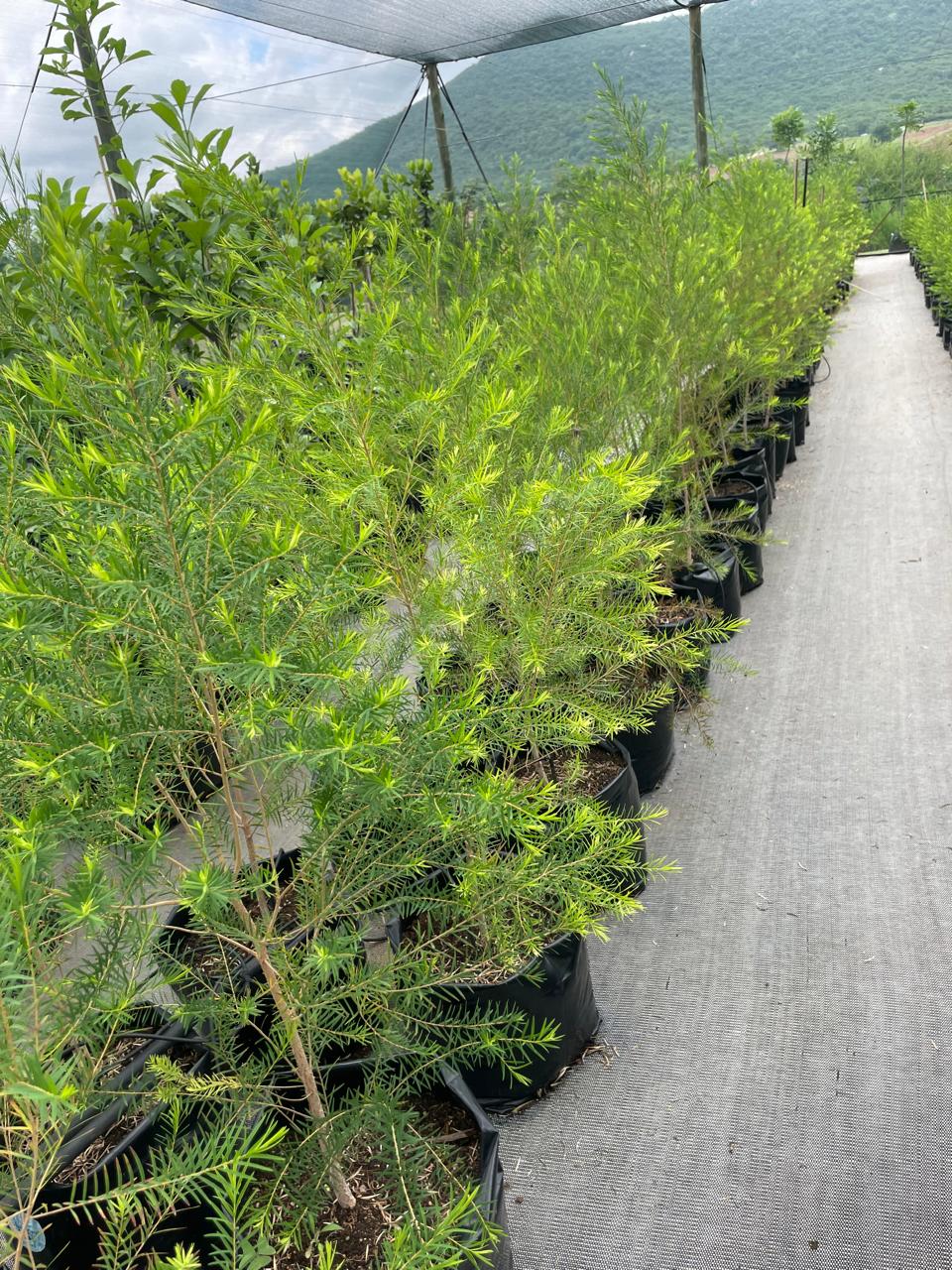
The hardy, hermaphroditic tea tree, also referred to as a shrub, grows up to about 6 or 7 metres and features papery bark. The leaves are linear, pointed and arranged irregularly. The flowers are small and white, with a shape reminiscent of callistemon.
Uses & Ecology #
The tea tree is especially known for the medicinal value of its non-irritant oil. Known for having antiseptic properties, it is used to treat fungal infections, rashes and wounds, amongst other things. The essential oil is also used in aromatherapy. Besides their cleansing and healing properties, the leaves repel mosquitoes.
Insects pollinate it and the wood is durable in wet conditions.
It is grown as a hedge or to stop soil from eroding.
Caution: Do not medically use or ingest any plant parts before consulting a qualified health practitioner. Any mentioned traditional uses are based on cultural practices and anecdotal evidence. They are not necessarily clinically proven or supported by modern scientific studies.
References #
- Gardener, The (n.d.) Melaleuca Alternifolia. Available at: https://www.thegardener.co.za/the-gardener/mm/melaleuca-alternifolia-2/ (Accessed: 26 November 2025)
- iNaturalist (n.d.) Narrow-leaved Paperbark. Available at: https://www.inaturalist.org/taxa/427159-Melaleuca-alternifolia (Accessed: 26 November 2025)
- Mountain Herb Estate (n.d.) Seed Information. Available at: https://www.herbgarden.co.za/mountainherb/seedinfo.php?id=70 (Accessed: 26 November 2025)
- Plant Selector (n.d.) Melaleuca alternifolia. Available at: https://plantselector.botanicgardens.sa.gov.au/Plants/Details/438 (Accessed: 26 November 2025)
- Plants for a Future (n.d.) Melaleuca alternifolia - (Maiden.&Betche.)Cheel. Available at: https://pfaf.org/user/Plant.aspx?LatinName=Melaleuca+alternifolia (Accessed: 26 November 2025)