Mint (Kruisement) #
Mentha species
Quick Info #
- Distribution & habitat: Originating in Europe
- Cultivation: Prefers rich, clammy, well-drained soil, though it could grow in any humid environment
- Family: Laminaceae
- Name origin: It is said to be named after Minthe, a nymph from Greek mythology
- Propagation: Takes place from rooted pieces taken from a mature plant
- Plant: perennial
Description #
The mint family is vast, reportedly with more than 600 members, of which Kruiekraal stocks a few. A monk of ninth-century Europe wrote that there were so many varieties, he’d sooner count the sparks of Vulcan’s furnace. Indeed, mints have been around for a long time, being found in containers at ancient burial sites, pyramids and temples. The Roman poet Ovid wrote of mint as a symbol of hospitality.
Mint is generally considered to be easy-growing and a very versatile herb. It can also be challenging to classify a particular mint specimen, because the different variants cross-breed quite easily.
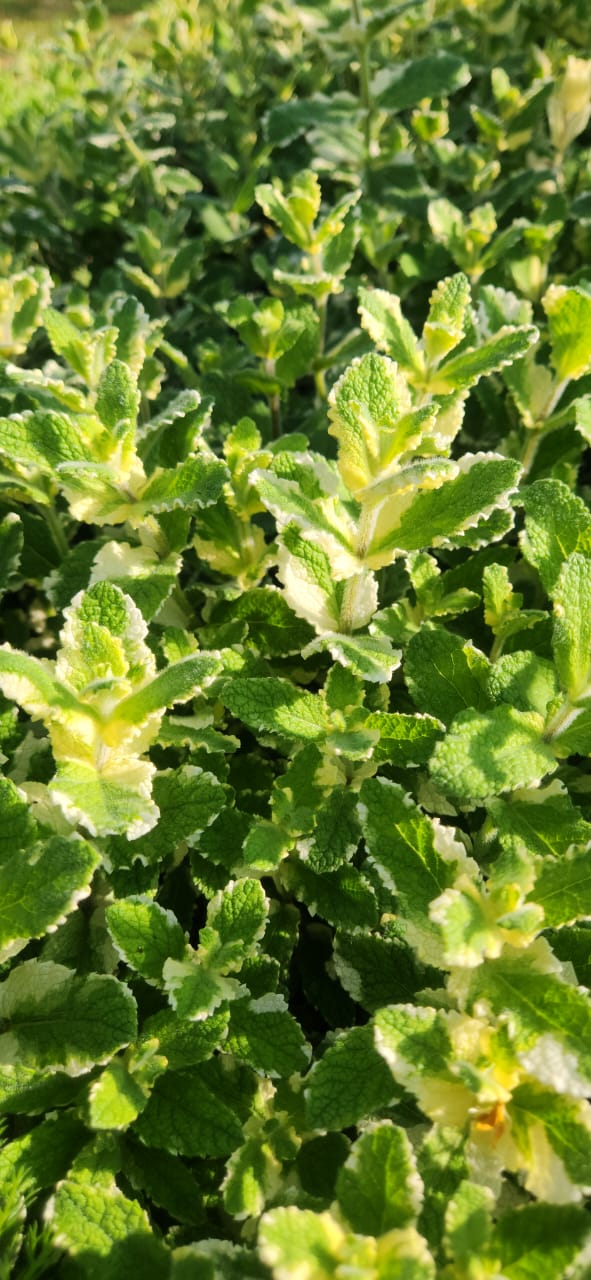
In size, mint can range from 3 cm to 1 m, depending on the variant. Mint has a creeping root stock and a green, square stem that branches in the upper part. The aromatic leaves are oval, pointed, short, stalked, and wrinkled from deep veins. Whorls of small flowers are in the axils of the upper leaves. Mint seeds are dark-brown, roughly spherical and small.
At Kruiekraal, the mint species include:
- Basil mint (Mentha x piperita): an upright grower with narrow leaves and a scent reminiscent of both basil and mint
- Chocolate mint (Mentha spicata ‘Chocolate’): has a flavour similar to that of peppermint crisp
- Garden mint (Mentha sachalinensis): best-known, with crinkled, glossy, green leaves and used to make mint sauce
- Pineapple mint (Mentha suaveolens): a pineapple-scented plant ideal for container growth
- Spearmint (Mentha spicata): long, sharp-pointed leaves, and distinctive flavour and smell
Uses & Ecology #
Warning: a specific mint variant called pennyroyal should not be consumed by pregnant women or people with kidney problems.
Mint is known for its fresh, sharp flavour, and sees extensive use in both culinary and medicinal contexts. It’s reported that mint is antiseptic and antispasmodic, increases perspiration, relieves pain, and stimulates the secretion of bile. Before the Middle Ages, Greeks and Romans used mint in bathhouses, as an insect repellant, in the sick room, and as a digestive aid.
Fresh mint leaves can be hung in the kitchen and periodically compressed to keep flies away. Dried leaves retain their flavour well for various uses. Poutpourri is enlivened by the addition of dried mint leaves.
It is said that colds and congestion may be relieved by inhaling the steam from mint twigs submerged in boiling water.
An extract from mint leaves is used to make tea, but don’t use Corsican mint or pennyroyal, as they are overly strong and bitter. Different tea blends can be created by mixing different kinds of mint.
Spearmint is used to make mint sauce, bringing out the flavour of lamb. Mint complements the flavour of various recipes, from sweet sauces to salads. Candied mint is used to decorate desserts. Historically, the Romans flavoured sauces and wines with mint.
Mint is used in bridal bouquets and wreaths, and its essential oil is highly valued.
An old, traditional view of mint is as a healing herb for various ailments, like adder and dog bites, digestion problems, gum and mouth infections, skin ailments, and stings. Mint reportedly helps with arthritis, jaundice, scorpion stings and snake bites.
Caution: Do not medically use or ingest any plant parts before consulting a qualified health practitioner. Any mentioned traditional uses are based on cultural practices and anecdotal evidence. They are not necessarily clinically proven or supported by modern scientific studies.
References #
- Bremness, L. (1998) The Complete Book of Herbs: A practical guide to growing & using herbs. South Africa: Southern Book Publishers (Pty) Ltd
- Christoffels, G. & Pauwels, I. (2006) Gekruid: Lewe Gesond en Lekker met Kruie Uit Jou Eie Tuin. Cape Town: Struik Publishers.
- Hey, B. (1992) A Celebration of Herbs for the South African Garden & Home. Cape Town: Struik Publishers (Pty) Ltd.
- Mountain Herb Estate (n.d.) Plant Information. Available at: https://www.herbgarden.co.za/mountainherb/herbinfo.php?id=393 (Accessed: 19 January 2026)
- Mountain Herb Estate (n.d.) Plant Information. Available at: https://www.herbgarden.co.za/mountainherb/herbinfo.php?id=62 (Accessed: 19 January 2026)
- Roberts, M. (1993) Alles oor Kruie. Cape Town: Struik Publishers.
- Roberts, M. (2012) My 100 Favourite Herbs. Cape Town: Struik Nature.