Basil (Basiliekruid) #
Ocimum basilicum
Quick Info #
- Distribution & habitat: native of Asia and India
- Cultivation: well-composted, well-dug soil and full sun (but preferring half-shade in midsummer)
- Family: Labiatae
- Name origin: either the Greek basileus, meaning “king”, or the Greek basilikos, meaning “royal”, or the word “basilisk”, from the view that the herb is an antidote for basilisk poison.
- Propagation: seed
- Plant: -
Description #
The vast cultivation of different basil variants has presented occasional challenges in distinguishing between them. This important, tropical, versatile herb is thought to have been brought out of Persia into Greece and then into Italy, where it became an essential herb in Italian cooking. The herb is said to have symbolized misfortune in Greece, and love in Italy.
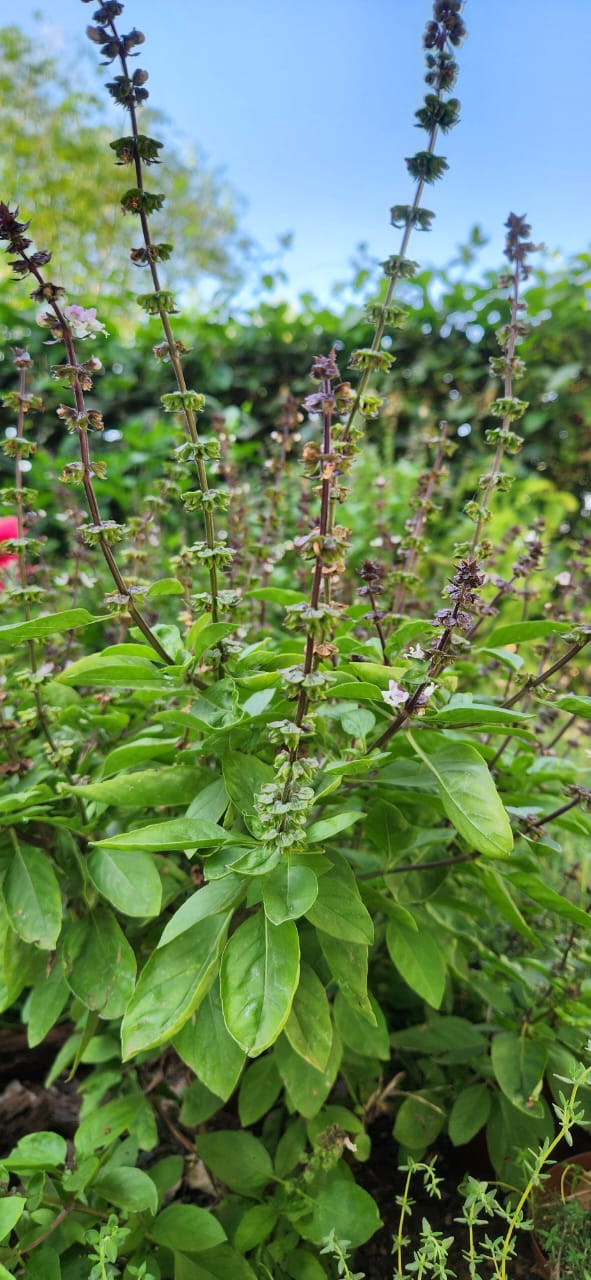
Commonly, the seed is dark-brown, faceted and tear-shaped. The flower is scented and small with whitish blooms that appear in circular clusters of six. The stem is branching, finely-ridged, hairy and light-green to reddish at the base. The leaf is bright-green, large, oval and toothed with a clove-like scent.
Basil is internationally a well-liked herb, reportedly cultivated for more than 4000 years, planted in the pharaoh’s garden in ancient Egypt and today used in traditional dishes of various parts of the world. The different varieties are generally considered easy to grow.
The variants at Kruiekraal are:
- African Blue Basil (Ocimum kilimandscharicum x basilicum ‘Dark Opal’): as a crossbreed, this variant may differ in properties from some information on this page.
- Columnar Basil / Mediterranean Basil (Ocimum basilicum).
- High Hopes Basil (Ocimum basilicum var. high hopes): perennial and sweet; prolific, sturdy and tall.
- Licorice Basil (Ocimum basilicum).
Uses & Ecology #
While variants differ in flavour, all have a flavour reminiscent of cloves. Basil is flavourful in salad or salad sauce. It forms the basis for pesto and goes well in dishes containing tomato, such as tomato bredie. It is a great pizza garnish and stimulates the appetite.
Basil has reportedly been used as a medicine since ancient times. It is taken internally for chills, colds and flu, and used to treat stomach inflammation and cramps associated with menstruation. It is used to aid digestion.
Basil tea is considered a detoxifier and a way to manage stress. It is used to treat coughs, delayed menstruation, hypertension, indigestion, migraines, mouth infections, nausea, palpitations, peptic ulcers and tonsillitis. The ancient Egyptians reportedly had multiple medical uses for it as well, including pain relief and the treatment of bladder and kidney ailments.
A cream is made to soothe pain and stiffness. Fresh leaves are rubbed against the temple for headache relief. A crushed basil leaf is applied to infected bites and stings. Basil bath vinegar is used to treat eczema, psoriasis, scalp infections and sunburn.
Crushed leaves are massaged around the heel to relieve tired feet. The crushed leaves are also said to stimulate hair growth when rubbed thoroughly onto the scalp.
Basil plants are placed on windowsills to repel flies. The dried twigs are said to repel mosquitoes if burned. Basil has various uses in aromatherapy.
Dried basil seed heads are attractive additions to bouquets. The seed heads can also be added to potpourri.
The leaves are stored for winter by drying them between layers of rough salt.
Caution: Do not medically use or ingest any plant parts before consulting a qualified health practitioner. Any mentioned traditional uses are based on cultural practices and anecdotal evidence. They are not necessarily clinically proven or supported by modern scientific studies.
References #
- Bremness, L. (1998) The Complete Book of Herbs: A practical guide to growing & using herbs. South Africa: Southern Book Publishers (Pty) Ltd.
- Christoffels, G. & Pauwels, I. (2006) Gekruid: Lewe Gesond en Lekker met Kruie Uit Jou Eie Tuin. Cape Town: Struik Publishers.
- Craze, R. & Webb, M.A (2004) The Herb & Spice Companion. New York: Barnes & Noble Inc.
- Hey, B. (1992) A Celebration of Herbs for the South African Garden & Home. Cape Town: Struik Publishers (Pty) Ltd.
- Roberts, M. (1993) Alles oor Kruie. Cape Town: Struik Publishers.
- Roberts, M. (2012) My 100 Favourite Herbs. Cape Town: Struik Nature.