Geranium (Malva) #
Pelargonium species
Quick Info #
- Distribution & habitat: widespread, but the greatest number of species is found in South Africa, especially the Cape of Good Hope. It is also indigenous to South Africa.
- Cultivation: most grow in full sun in average, well-drained soil and a well-ventilated position
- Family: Geraniaceae
- Name origin: the word “geranium” comes from the Greek geranus, which means crane – referring to the beaked fruit
- Propagation: from cuttings, sometimes seeds
- Plant: tender evergreen perennial
Description #
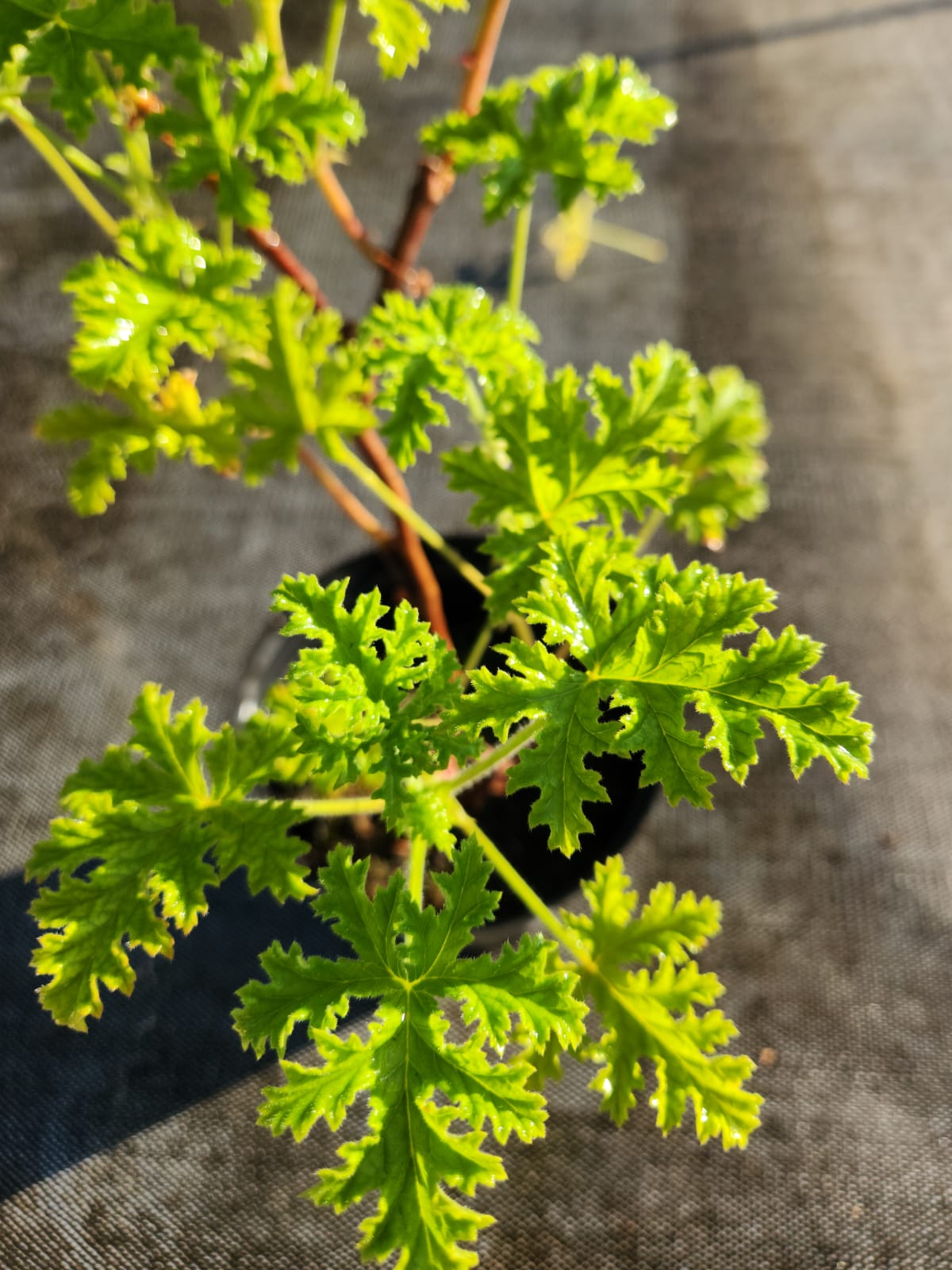
It’s been written that geraniums and pelargoniums are supposed to be separate genera, but also that they’re often confused and therefore all called geraniums. They’re strongly aromatic herbs, which explains the common names “scented geranium” and “scented pelargonium”. The herb is about 250 species strong and became well-known in 1847 when the French perfume industry began to make proper use of its aromatic value. The leaves are generally hairy, mid-green, rose-scented and toothed, with five to seven lobes. Dried leaves and leaves that die on the plant retain their scent well. The stem is green, hairy and round, becoming woody. Geraniums generally range between 15 to 120 cm in height, depending on the variant, but the odd greater height is reported.
Here are the variants available at Kruiekraal:
- Citronella Geranium (Pelargonium citronellum): upright and tender with deeply cut, crinkled and serrated leaves and a sharp, citrus-like scent when bruised.
- Lemon-Scented Geranium (Pelargonium crispum): up to 50 cm tall and has crisp, curled, light-green leaves. Its scent is also described as orange.
- Rose-Scented Geranium (Pelargonium graveolens): up to 1,5 m tall in extreme cases, with moderately-serrated leaves and growing well in dry conditions.
- Wild Rose Geranium (Pelargonium capitatum): similar lengths as graveolens with shallow serrations and pink flowers with red-purple veins.
Uses & Ecology #
Warning: rose-scented geranium is reportedly the only variety of the pelargonium species that is edible.
The leaves are rubbed on oily or paint-covered hands to get rid of the muck. Hair can similarly be cleaned with the extract resulting from leaves added to bath-water. A leaf extract can be a light astringent to cleanse and improve blood flow. A leaf extract is also considered a cure for diarrhoea and dysentery.
The flowers are tossed in salads. Leaves are finely chopped and used to flavour various foods.
An essential oil has appeared in a recipe for a stress treatment, and is used in aroma-therapy massages for premenstrual tension and fluid retention, dermatitis, dry skin, eczema and herpes. Used in skin cream, the essential oil balances sebum of oily and dry or inflamed skin. Geranium is also listed under treatments of fungal skin infections.
The aroma of the leaf can be utilised by adding it to pillows and potpourri. A herb pillow containing geranium is said to help one fall asleep.
Geraniums have bright flowers that make them valued pot plants or help to beautify the garden.
Historically, the Khoikhoi used geraniums to make medicine, pap and tea. South Africa’s indigenous people have used geraniums in washes.
Caution: Do not medically use or ingest any plant parts before consulting a qualified health practitioner. Any mentioned traditional uses are based on cultural practices and anecdotal evidence. They are not necessarily clinically proven or supported by modern scientific studies.
References #
- Bremness, L. (1998) The Complete Book of Herbs: A practical guide to growing & using herbs. South Africa: Southern Book Publishers (Pty) Ltd
- Foster, S. & White, L.B. (2000) Kruie in die Apteek. Parklands: Jacklin Publishers.
- Gardenia (n.d.) Pelargonium ‘Citronella’ (Scented Geranium). Available at: https://www.gardenia.net/plant/pelargonium-citronella (Accessed: 19 January 2026)
- Hey, B. (1992) A Celebration of Herbs for the South African Garden & Home. Cape Town: Struik Publishers (Pty) Ltd.
- Roberts, M. (1993) Alles oor Kruie. Cape Town: Struik Publishers.
- Roberts, M. (2012) My 100 Favourite Herbs. Cape Town: Struik Nature.