Parsley (Pietersielie) #
Petroselinum crispum
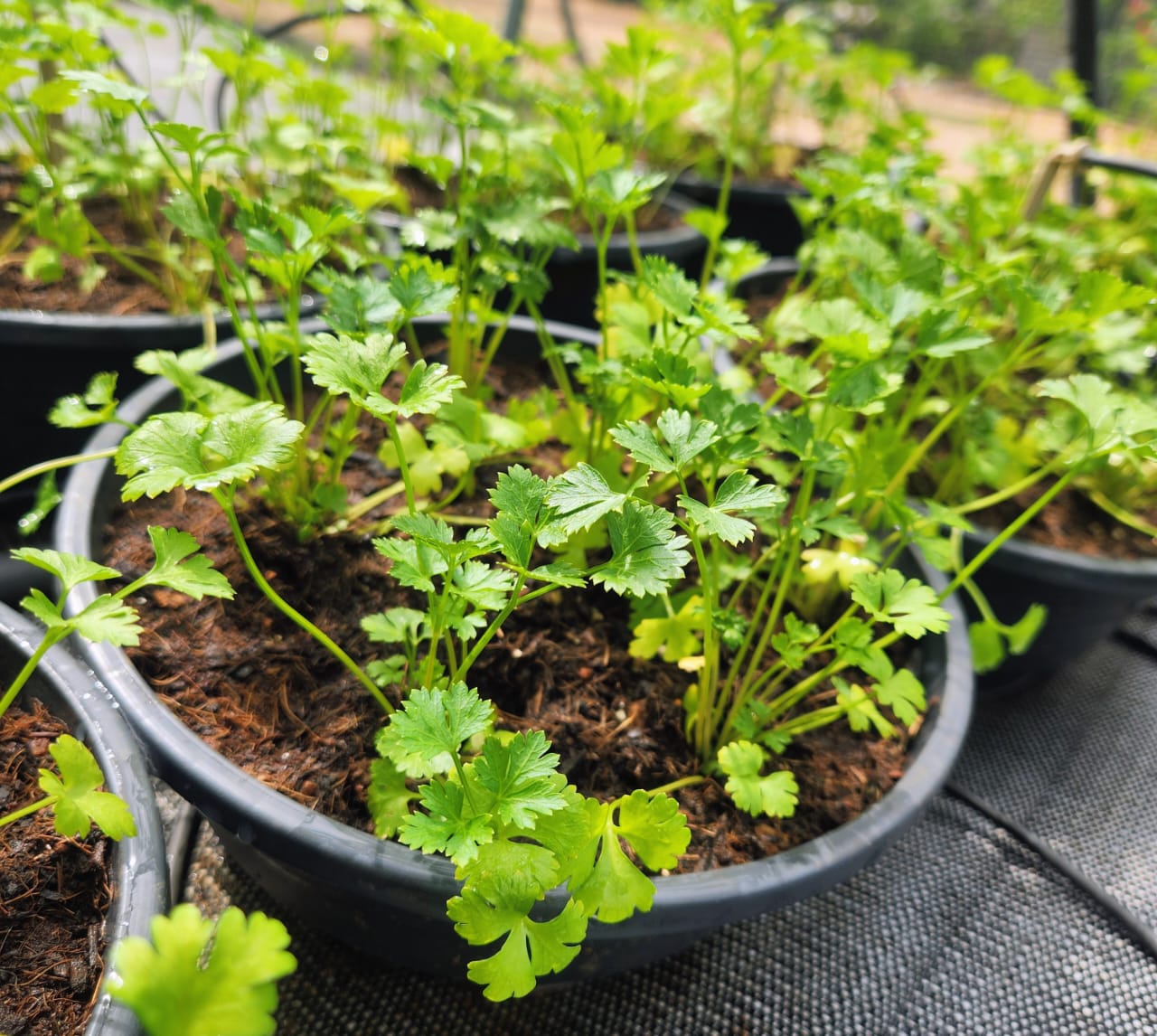
Quick Info #
- Distribution & habitat: Mediterranean
- Cultivation: ideally rich, moist, well-composted, well-dug soil and lots of sun
- Family: Umbelliferae
- Name origin: “parsley” comes from the Greek petroselinon, meaning rock celery, because the herb thrives on rocks and walls.
- Propagation: by way of seeds
- Plant: biennial
Description #
The slow-growing parsley herb, reaching between 15 and 25 cm in height, is sometimes called the king of herbs. While it was used for a long time for medicinal purposes, the use as a kitchen herb is a more recent historical development (though by “more recent”, Roman times are meant). It reached England in the 16th century and was taken to America by the first British settlers.
If dried quickly, the leaves retain flavour. Commonly, the leaves are bright green and curled with toothed margins. The taproot is brownish-yellow, thin, and smooth, with tiny, hair-like roots. The stem is branching, mid-green, ridged, semi-circular and solid.
Available at Kruiekraal:
- Flat-Leaf Italian Parsley (Petroselinum crispum var. neapolitanum): this variety has fern-like, flat leaves and grows taller than the curly sort. It won’t go to seed in hot weather as easily as other varieties do. The leaf flavour is also more pronounced than that of other varieties.
Uses & Ecology #
Warning: Avoid during pregnancy due to the stimulant effect on the uterus.
Parsley is a ubiquitous garnish with a taste described as somewhat mild. It’s used in soups, over vegetables, in herb butters and in a plethora of dishes. Parsley is also thought to stimulate the appetite and contains calcium, iron and vitamins A, B1, B2 and C. The high vitamin content is linked with brightening the eyes and toning the skin.
Parsley is a good companion plant for roses and tomatoes, keeping insects away.
Parsley tea is made from the fresh leaves. This tea is used to treat kidney and bladder infections. Other reported medicinal uses include the treatment of jaundice and sciatica. There has long been a perception of parsley as a digestive and diuretic.
Dried parsley leaves serve as colourant.
Caution: Do not medically use or ingest any plant parts before consulting a qualified health practitioner. Any mentioned traditional uses are based on cultural practices and anecdotal evidence. They are not necessarily clinically proven or supported by modern scientific studies.
References #
- Bremness, L. (1998) The Complete Book of Herbs: A practical guide to growing & using herbs. South Africa: Southern Book Publishers (Pty) Ltd
- Craze, R. & Webb, M.A (2004) The Herb & Spice Companion. New York: Barnes & Noble Inc.
- Hey, B. (1992) A Celebration of Herbs for the South African Garden & Home. Cape Town: Struik Publishers (Pty) Ltd.
- myspicer.com (2014) The History of Parsley. Available at: https://www.myspicer.com/history-of-parsley/ (Accessed: 29 January 2026)
- Roberts, M. (1993) Alles oor Kruie. Cape Town: Struik Publishers.
- Roberts, M. (2012) My 100 Favourite Herbs. Cape Town: Struik Nature.