Monkey Thorn (Apiesdoring) #
Senegalia galpinii
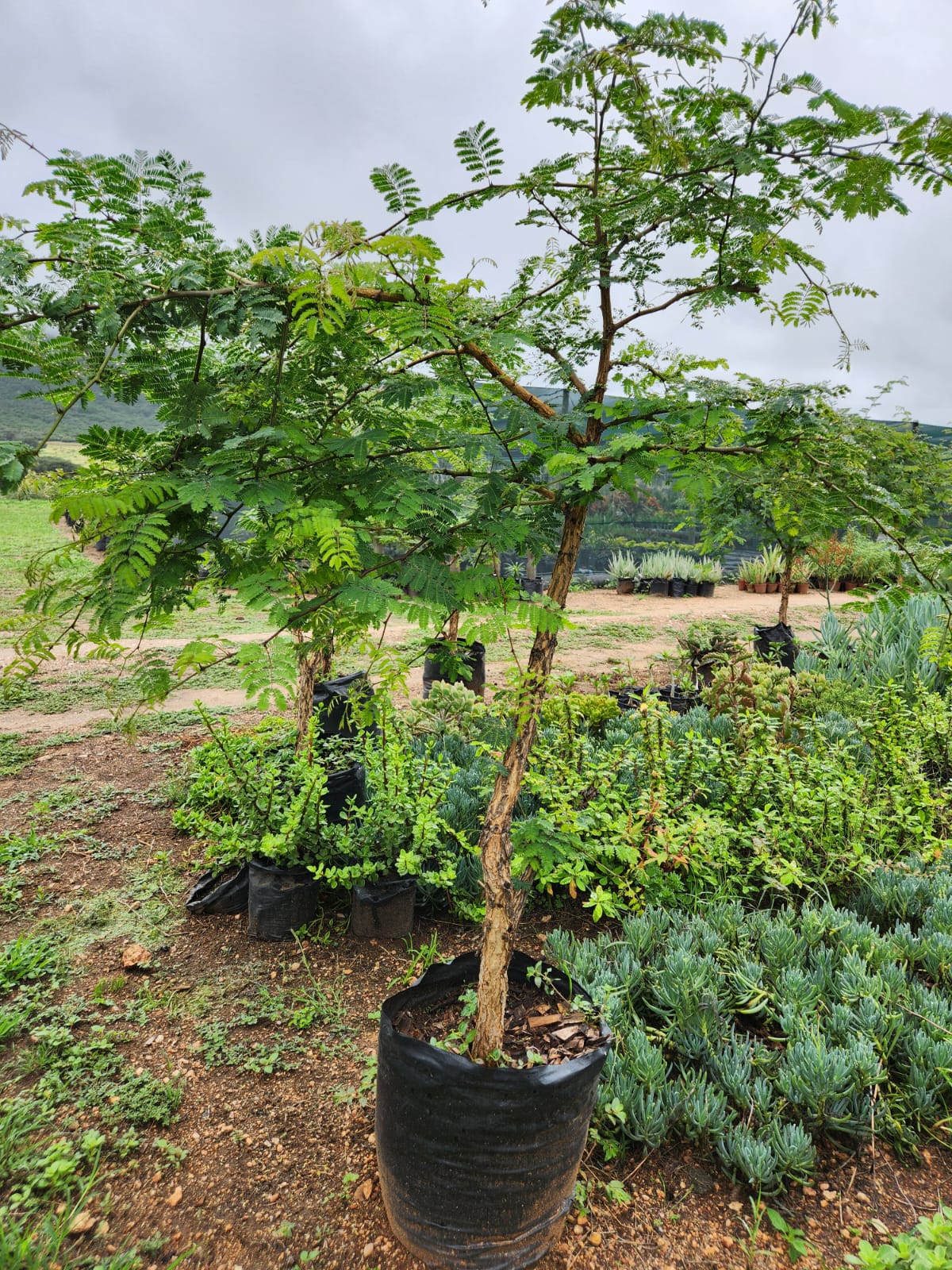
Quick Info #
- Distribution & habitat: northern and eastern Botswana, Malawi, South Africa (Limpopo and North-West), Zambia and Zimbabwe – open, wooded grassland, open woodland and near streams
- Family: Fabaceae
- Florescence: September to October
- Fruiting: February to March
- Leaf habit: deciduous
- Name origin: named in honour of Ernest Galpin, a plant collector. “Senegalia” is derived from “Senegal”. The common name refers to its attraction of monkeys and possibly the thorns on the base of the trunk.
- Other names: Molopa (North Sotho), Tshikwalo (Tshivenda), umbrella thorn
Description #
The typically-symmetrical monkey thorn tree can grow quite large – up to about 25 to 30 metres. Thorns, growing up to 5 centimetres long, can be found on the swollen base of the trunk and on the branches in curved pairs.
The bipinnate leaves are light-green, consisting of 6 to 12 glossy, oval-shaped leaflets. The bisexual flowers, blooming in clusters, are creamy to light-yellow and the brittle fruits are reddish to purplish-brown pods, which burst open to release the seeds.
The bark is whitish-yellow or greyish-brown at first, then becomes brown or blackish, possibly featuring many grooves along the tree’s length. When young, the branches may be creamy yellow, dark-reddish brown to olive-brown or purplish and be covered with short, soft hair.
Uses & Ecology #
Considering its large size and striking light-green canopy, the monkey thorn tree is something to witness in large parks or yards. There, it can also provide ample, dappled shade.
In the Limpopo and North-West provinces, the monkey thorn tree is considered a sign of sweet veld, which retains its nutritional value in winter.
The monkey thorn plays an important role in supporting wildlife in savannas and woodlands.
Monkeys seek refuge in the wide branches of this tree, sometimes eating the fruits. This may form part of how the seeds are dispersed. Birds also seek refuge among the foliage, and various insects are attracted to the flowers.
The tree’s root system helps prevent soil erosion. The durable wood has found use in the making of furniture and tools. It has also been used as firewood. Some traditions hold that the plant has healing properties.
Caution: Do not medically use or ingest any plant parts before consulting a qualified health practitioner. Any mentioned traditional uses are based on cultural practices and anecdotal evidence. They are not necessarily clinically proven or supported by modern scientific studies.
References #
- Botanical Realm (2025) Monkey Thorn (Senegalia Galpinii). Available at: https://www.botanicalrealm.com/plant-identification/monkey-thorn-senegalia-galpinii/ (Accessed: 12 December 2025)
- Mutshinyalo, T. (2003) Senegalia galpinii. Available at: https://pza.sanbi.org/senegalia-galpinii (Accessed: 12 December 2025)
- Tree SA (n.d.) Senegalia galpinii. Available at: https://treesa.org/senegalia-galpinii/ (Accessed: 12 December 2025)